Why Christianity Makes Zero Sense to Me
Introduction
To start, I was raised Catholic and genuinely believed it into the early teenage years. Well, actually, my mom was a “spiritual, not religious buddhist” who sent me to years of catechism, communion, and confirmation classes for “exposure to religious culture.” Around age 14, I had a very unpleasant weeks-long existential crisis centering around the existence of Hell. Initially Christian Universalism seemed to be the answer, before I eventually returned to normalcy as a strong optimistically nihilist Atheist.
Shortly after this, my mom also took me to one mass of the “Life.Church” evangelical cult; a “church” that employs young streetwear-clad emcees to give a feel-good populist introduction before piping in a prerecorded “sermon” from the cult’s charismatic leader. This “church” has $100 million in tax-free, liquid (presumably interest-bearing) assets, while also demanding a 10% tithe to build more theaters churches to perpetuate the mind-virus even further. The final nail in the coffin came several years later when my childhood priest was outed as a child molester and ended up being punished by his diocese, not the law.
This article is not a serious intellectual rebuke of the Christian take on these fallacies; that would require me to waste my time studying millennia of theology and mental gymnastics that ultimately concede “God works in mysterious ways || Our logic is fundamentally flawed || It’s actually all symbolic.” Rather, I want to lay out these issues from a layman’s perspective.
Evolution of the Soul
Assumptions
The Vatican holds that biological evolution is scientific fact, which I’ll be focusing on. Young-Earth creationism is pointless to consider because it’s been debunked by DNA evidence, carbon dating, and a mountain of other scientific observations. “Soul” in this context refers to the notion that humans are sapient, inherently moral, created in God’s image, and have free will leading to the ability to be saved.
Boolean Souls
As I see it, having a soul is a true-false attribute. One is either animalistic, or has the ability to devote their life to Jesus and be saved. Which naturally begs the question: when did humans acquire souls? Here are some potential milestones:
- The first stone tools? Other great apes are known to use tools
- Anatomical modernity? Neanderthals existed alongside, and bred with, “modern humans” before being outcompeted. They are thought to have created art and buried their dead, but complex language is less likely.
- Behavioral modernity? Humans circa 40,000 BCE are known to have created art, and had likely developed complex language and abstract reasoning skills. This seems like a good basis for God to start divining humans with souls
- The Neolithic revolution? Too late. The development of farming and society doesn’t mean the hundreds of prior generations were any less capable of putting their faith in God.
So, where exactly is the threshold? Evolution took millions of years to produce hominids that gradually trended towards “modern humans.” Genesis asserts that the “first humans” were just like us. Some Christians argue that Adam and Eve were placed on Earth once God had created the ideal human body through evolution. But this implies that countless sapient human creatures never had the opportunity to be saved, despite believing in higher powers, because they weren’t “God’s children.” And if that’s the case, how did the soulless humans suddenly disappear shortly after outcompeting the Neanderthals? Other Christians argue that God arbitrarily promoted humans to their modern, soulful state at the tail end of natural evolution. But this is still just genesis-style creationism arbitrarily tacked onto the end of evolution to satisfy the logical constraint of boolean soulfulness coexisting with archaeological evidence.
An Unfair Test
Christianity is fundamentally a test of faith: turn yourself over to God and spend eternity with him. But upon examination, the deck is unfairly stacked against us.
Assumptions:
- God loves us and wants us to be saved
- Salvation depends on faith in God
- Jesus performed miracles as undeniable proof that God exists
Christians posit that faith without proof is the test. But I would argue that a much better test would be choosing to live a moral life devoted to God, knowing that it’s the right thing to do. Just like Atheists who choose to live a moral life, despite a lack of belief in any reward or salvation for doing so. Sin, paganism, and atheism didn’t disappear during Jesus’s time, despite direct first-hand evidence of a higher power’s existence. In fact, Man killed God in cold blood. Satan had full knowledge of God’s power and grace, and still decided to revolt!
I’ve heard the argument that sending a new messiah every generation would be absurd. And it would! But that’s completely unnecessary; a universal shared experience unexplainable by science is more than enough. For example, God whispering the same message into every living human’s ear simultaneously. The least God could’ve done is make his Son (himself?) fully literate, so that he could’ve written down the exact message as intended, rather than having nine fallible humans transcribe the message over a period of fifty years after Jesus was already dead.
Belief without evidence may have been a workable solution hundreds of years ago, but modern society has (rightfully) conditioned us that blind trust and faith leads to scams (“prosperity gospel”), cults (Hale—Bopp), poison (radium supplements), conspiracy theories (flat Earth), and other ills.
The Problem of Evil (and free will)
Given the assumptions laid out in the last section, why does God allow Evil to exist? The first answer Christians jump to is “original sin,” the idea that humanity as a collective turned away from God and fell from grace; individual people have free will yet are held accountable for the decisions of two humans thousands of years before they were born. Would a benevolent, loving God allow his extremely fallible creations to fall away from him in the first place? And why not make a modicum of effort to guide them back to salvation?
I’m going to completely sidestep the paradox of an omniscient God with full knowledge of the future, that somehow also respects free will in a predetermined yet non-deterministic universe. Assuming the former is true, God created Satan with the express knowledge that Satan would riddle the Earth-to-be with evil and turn God’s beloved children away from him, leading to unimaginable human suffering. If the latter is true, a benevolent, all-loving, and omnipotent God chose to let this continue, despite having the ability to immediately correct the situation. If free will is true, and God is omnipotent, is he non-interventionist? Clearly not, or Jesus wouldn’t have been sent in a half-assed attempt to “save” us.
Eternal Life
Despite eternal fire-and-brimstone hell not having a biblical basis, Catholics wholeheartedly believe in it, which permanently turned me off their religion. Some Christians believe in annihilation for unsaved souls, which seems to be the obvious choice once you consider what eternity means. Any eternity is arguably the worst punishment a human mind can imagine. Some argue that Heaven exists outside of time and that being with God transcends any possible human experience. To me, this sounds like I’ll be transformed into fundamentally different from a human consciousness, or effectively the same as annihilation.
Rather than try to explain the unfathomable concept of eternity, I’ll drop a few pieces of media I’m fond of:
Optimistic, absurdist nihilism legitimately makes life much more enjoyable for me and brings a sense of comfort. My own life will end, my culture and civilization will end, Humanity will end, Earth will be rendered uninhabitable, and the Universe will end in a fog of maximum entropy or a similar fate.
Conclusion
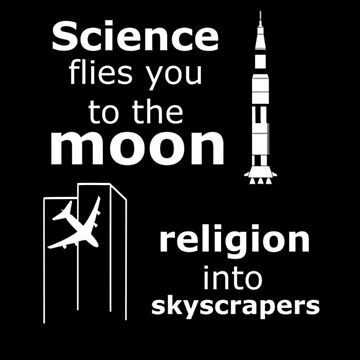
—Victor J. Stenger
I believe that organized religion is obsolete and society would be better off without it. You’re welcome to email me tearing this essay to shreds, but be warned that I will treat your reply as comedy gold and not engage a debate.
Last modified: 2026-10-10